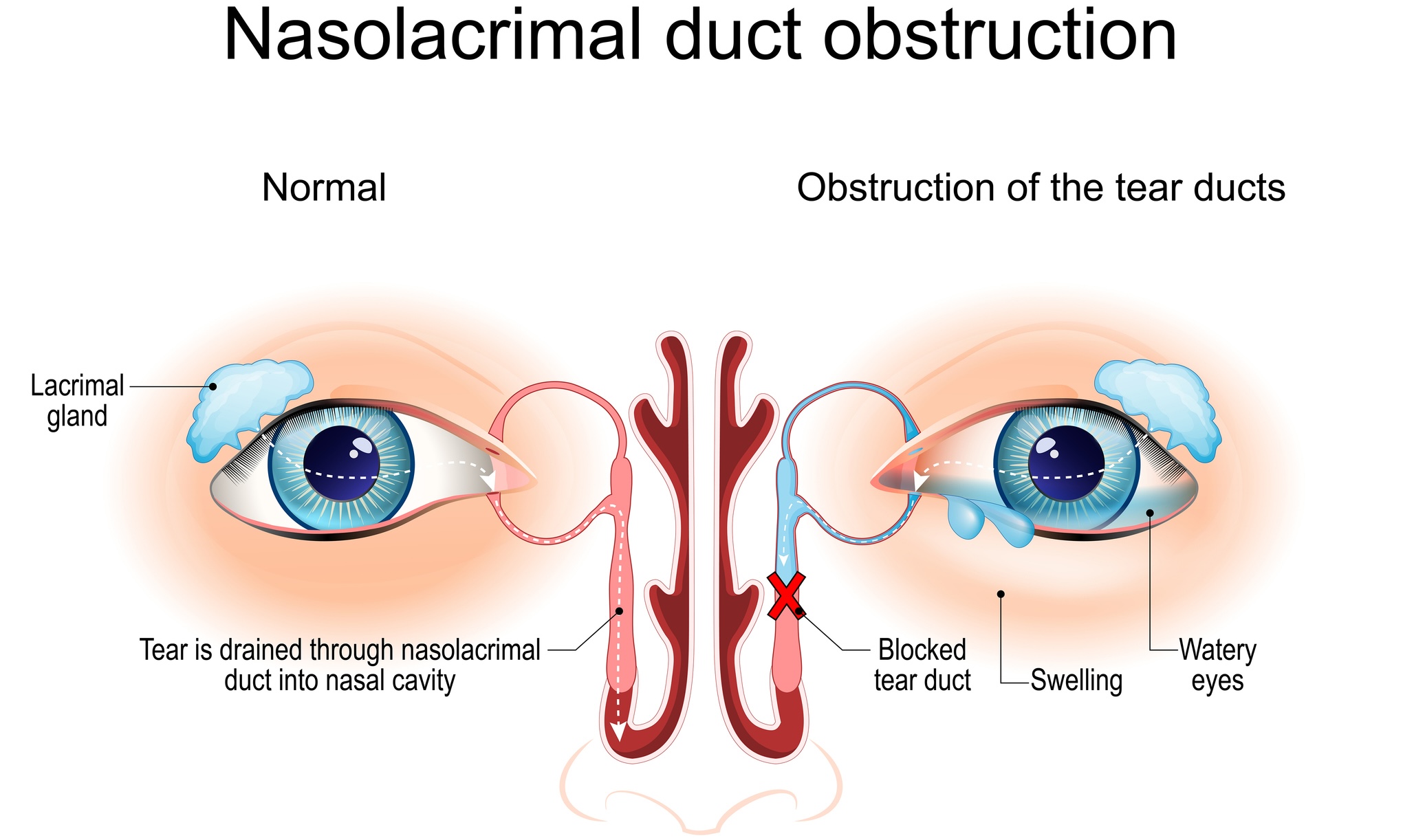
Tears are produced by the lacrimal gland and drain through a small opening in the upper eyelid and lower eyelid, then into the tear sac (also called the lacrimal sac) before flowing through the nasolacrimal duct into your nasal cavity. When any part of this system narrows or closes off, tears back up instead of draining normally. This is known as tear duct obstruction, and it can cause excess tears, yellow discharge, redness, and repeated infections in the tear sac, sometimes progressing to chronic dacryocystitis or, in severe cases, acute dacryocystitis. The condition can affect one or both eyes and may develop from aging, chronic sinus issues, injury, or scarring from a prior infection.
| Type of Surgery |
General Reasoning of Procedure |
| Endoscopic Lacrimal Surgery |
Location and intensity of blockage dependent |
| DCR Surgery |
Most common treatment for blockages |
| Balloon Catheter Dilation |
Partial obstructions and most common solution for children |
| Jones Tube Placement |
Severe blockages or previous unsuccessful DCR surgery |
Endoscopic Lacrimal Surgery
Our oculoplastic surgeon utilizes endoscopes and advanced surgical devices for endoscopic lacrimal surgery. This minimally invasive approach allows treatment without a skin incision, resulting in faster surgery, less visible scarring, and a quicker recovery.
Dacryocystorhinostomy (DCR Surgery)
The most common treatment for tear duct obstruction. External DCR uses a small incision to create a pathway between the lacrimal sac and nasal cavity. Dr. Mahan has advanced training in Endoscopic DCR surgery, a minimally invasive alternative through the nasal passage, without the need for an external incision.
Balloon Catheter Dilation
A balloon catheter dilation may be recommended for partial blocks. This is a minimally invasive procedure where a small catheter with an inflatable balloon opens the blocked tear duct for partial obstructions.
Jones Tube Placement
For severe cases where DCR surgery is unsuccessful or significant scarring is present, a small glass Jones tube is permanently placed through the lower eyelid to maintain tear drainage from your eyes to your nose.

 Take the Next Step. Request a Surgical Consultation.