
Astigmatism Testing
Frequent headaches, eye strain, and blurry or distorted vision at any distance can point to astigmatism, one of the most common refractive errors affecting how light rays focus inside the eye. At Visionary Eye Doctors, our Rockville, MD office offers comprehensive eye exams and astigmatism testing using advanced diagnostic technology. Whether your symptoms are mild or more pronounced, we build a treatment plan around your lifestyle, from glasses and contact lenses to advanced refractive surgeries including LASIK, photorefractive keratectomy (PRK), and implantable contact lenses for patients who qualify.
 Take the Next Step. Request a Consultation.
ASTIGMATISM CARE IN DC AND MARYLAND
Astigmatism testing and treatment call for an eye doctor who takes the time to get your diagnosis right and explain your options clearly. At Visionary Eye Doctors, our team offers full-service ophthalmology care under one roof, from routine comprehensive eye exams to advanced refractive surgeries including LASIK, photorefractive keratectomy (PRK), and implantable contact lenses, so you never have to search for a separate specialist as your treatment plan evolves. Call us at (301) 591-1763 or contact us online.
What Is Astigmatism?
Astigmatism is a refractive error that occurs when the cornea or the lens inside the eye has an irregular shape rather than a smooth, evenly curved surface. Instead of light rays focusing on a single point on the retina, an astigmatic eye scatters that light across multiple points, which causes blurred or distorted vision at both near and far distances. Corneal astigmatism happens when the cornea itself is irregularly shaped, while lenticular astigmatism refers to an irregular shape in the eye’s internal lens.
Astigmatism often occurs alongside other refractive errors, including myopia, hyperopia, and presbyopia, and both types are correctable with the right glasses prescription, toric contact lenses, or refractive surgery.
Levels of Astigmatism
Astigmatism exists on a spectrum, and the level you have determines how noticeable your symptoms are and what type of correction works best.
- Slight astigmatism (Up to 0.75 diopters): Often goes unnoticed and may not require correction, though regular eye exams help track any changes over time.
- Mild astigmatism (0.75-2 diopters): May cause occasional blurry vision, especially at night or with contrast vision in dim lighting, and can usually be corrected with glasses or standard contact lenses.
- Moderate astigmatism (2-4 diopters): Tends to cause more consistent blurred vision, eye strain, and frequent headaches, and typically requires a specific glasses prescription or toric lenses for clear vision.
- Severe astigmatism (4 or more diopters): Can significantly affect visual acuity and daily activities, often requiring toric lenses, a specialized glasses prescription, or a discussion about refractive surgery with your eye doctor.
An eye specialist at Visionary Eye Doctors can determine where your astigmatism falls on this scale through a visual acuity test and a full eye exam that evaluates your eye’s shape.
Causes of Astigmatism
Astigmatism develops when the cornea or the eye’s lens grows into an irregular shape instead of the smooth curve needed to focus light rays properly. In many cases, astigmatism is present from birth and tends to run in families, meaning genetics play a large role in whether you develop this refractive error. Astigmatism often occurs alongside other vision problems, such as nearsightedness or farsightedness, since all three relate to how the eye focuses light. While astigmatism itself isn’t caused by reading in low light or sitting too close to a screen, those habits can worsen eye strain in someone who already has an uncorrected refractive error. It can also change gradually over time, sometimes appearing or increasing after an eye injury, certain types of eye surgery, or conditions like keratoconus that thin and reshape the cornea.
Because the causes vary from person to person, regular eye exams are the best way to catch astigmatism early and understand what’s behind your specific symptoms.

Diagnosing Astigmatism
Common Symptoms of Astigmatism
Astigmatism symptoms can be subtle at first, which is why many people live with mild astigmatism for years before seeking treatment. Common signs include:
- Blurry or blurred vision at any distance
- Difficulty seeing fine details
- Trouble with contrast vision in low light or at night
- Eye strain after reading, driving, or looking at screens for long periods
- Frequent headaches that seem to worsen throughout the day
- Squinting to bring objects into focus
- Difficulty with night driving due to glare or halos around lights
If you notice any of these symptoms of astigmatism, scheduling an eye exam is the best next step, since these signs can also overlap with other vision problems that require different treatment approaches.
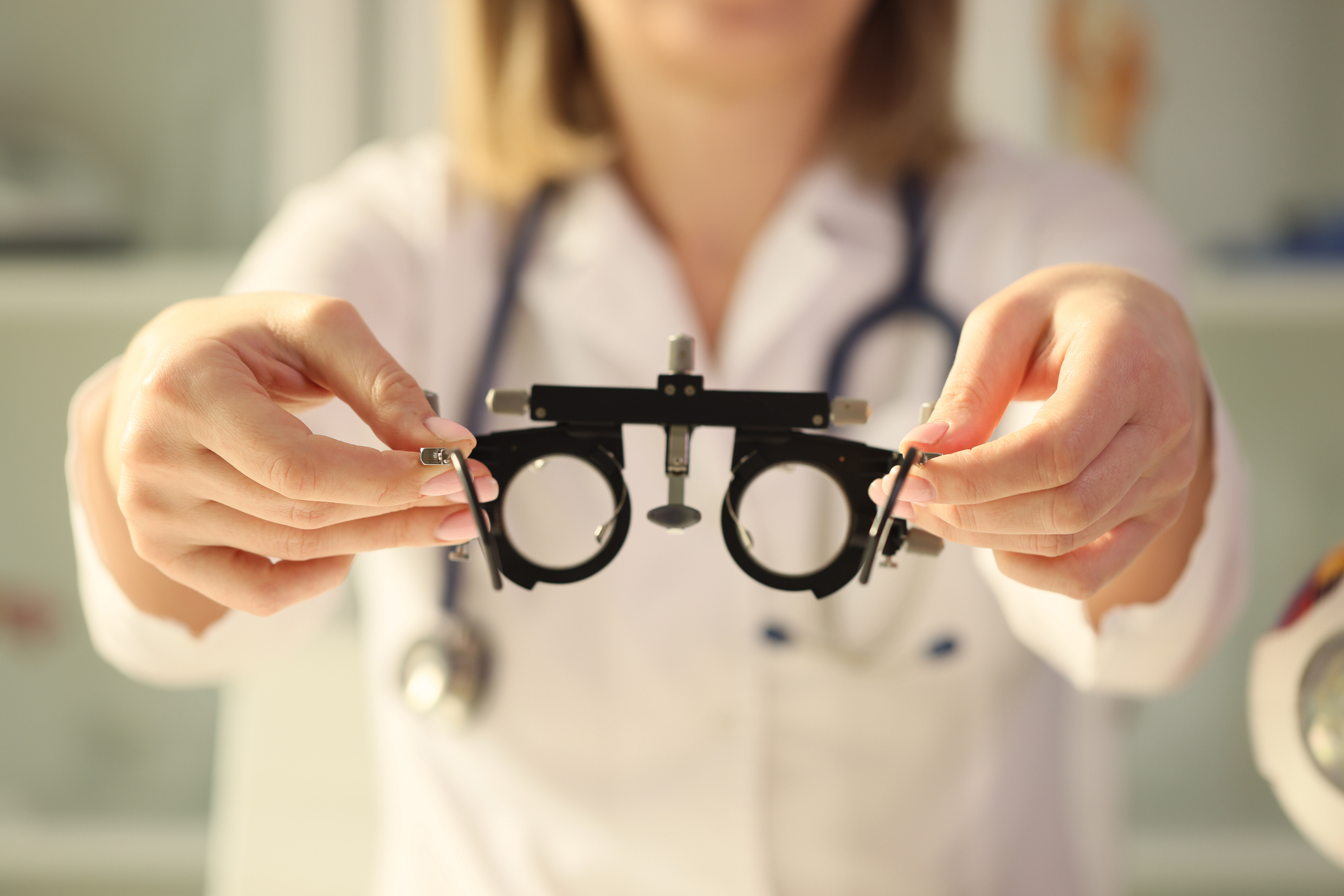
What to Expect During Your Eye Exam
The entire eye exam process is painless and typically takes less than an hour. Here is what you can expect in your appointment:
- Visual Acuity Test: Your eye exam for astigmatism will start with a visual acuity test using a standard eye chart to measure how clearly you see at different distances.
- Determining Your Prescription: Your eye doctor will then use specialized instruments to measure the curvature of your cornea and determine your exact glasses prescription.
- Refraction Test: Your eye exam may include a refraction test, where you look through a series of lenses to identify which combination brings images into the sharpest focus.
- Additional Testing: Your doctor may perform additional testing to evaluate your visual field and overall eye health to rule out other eye problems.
- Next Steps: After your eye exam, your eye doctor will walk you through the results before recommending next steps for astigmatism correction.
Treating Astigmatisms
Corrective Lenses
For most patients, correcting astigmatism starts with either eyeglasses or contact lenses. Toric lenses are specially designed contact lenses that correct the irregular curvature causing astigmatism, unlike standard lenses for refractive correction, however, combination lenses are also available for those who need vision correction for both. Your eye doctor will fit you with the right lens type and power, and a follow-up contact lens exam will be scheduled. Many patients notice a significant improvement in clarity almost immediately after starting corrective lenses.
Refractive Surgery
Patients looking for a longer-term solution to astigmatism correction may be candidates for refractive surgery. Procedures like LASIK use precise lasers to reshape the cornea, correcting the irregular curvature that causes light to scatter instead of focusing properly, which can reduce or even eliminate the need for glasses or contact lenses.
An eye doctor will first confirm that your cornea, vision problems, and health history make surgery a safe and effective option. Our team will also walk you through the risks, benefits, and expected recovery so you can make an informed decision alongside your doctor’s medical advice.
Why Choose Visionary Eye Doctors for Astigmatism Testing and Treatment
Our fellowship-trained and board-certified eye doctors use advanced diagnostic technology to pinpoint the exact nature of your astigmatism, whether corneal or lenticular, mild or severe, and build a personalized correction plan around your lifestyle and goals.
With locations across Washington, DC, Bethesda, Gaithersburg, Damascus, Rockville, and Riderwood, quality eye care is never far from home. Patients consistently choose us because we combine medical expertise with a genuinely compassionate, patient-first approach to every visit. If blurry vision, eye strain, or frequent headaches have been affecting your daily life, schedule your astigmatism test with Visionary Eye Doctors and take the first step toward clearer vision.
FREQUENTLY ASKED QUESTIONS
What is the difference between mild and severe astigmatism?
Mild astigmatism causes minor blurring, often noticeable only in certain lighting or at night, and can usually be corrected with standard glasses or contact lenses. Severe astigmatism causes more significant distortion across all distances and typically requires toric lenses, a specific glasses prescription, or a conversation about refractive surgery to achieve clear vision.
Can astigmatism get worse over time?
Yes, astigmatism can change gradually as you age or due to factors like an eye injury or a condition such as keratoconus. This is why regular eye exams matter even if your vision problems have felt stable, since small changes in corneal shape can affect your glasses prescription over time.
Can I take an online astigmatism test?
An at-home astigmatism test completed online can be a helpful first indicator if you’re noticing symptoms of astigmatism, but it cannot replace a comprehensive eye exam. Only an eye doctor using proper diagnostic equipment can accurately measure your visual acuity and corneal curvature to confirm a diagnosis and recommend treatment.
Do I need glasses or contact lenses for astigmatism, or can it be corrected another way?
Most patients with astigmatism find that corrective lenses, either glasses or toric contact lenses, provide clear and comfortable vision. For those who want to reduce their reliance on lenses, refractive surgery may be an option after a full evaluation confirms candidacy.
How often should I get an eye exam if I have astigmatism?
Most patients with astigmatism benefit from an eye exam once a year to monitor for any changes in their prescription or eye health. Your eye doctor may recommend more frequent visits depending on the severity of your astigmatism or if you’re experiencing new symptoms like eye strain or frequent headaches.