
Does FSA Cover LASIK? Using Your FSA or HSA for Laser Eye Surgery
You can use FSA or HSA funds to pay for LASIK because the IRS counts vision correction surgery as an eligible medical expense. This allows you to pay for the procedure with pre-tax dollars and lower your out-of-pocket expense.
LASIK is an elective procedure, so most health insurance plans do not cover it. The good news is that a flexible spending account (FSA) or health savings account (HSA) both let you set aside money before taxes and spend it on qualified medical procedures, including laser vision correction.
Below we’ll cover how FSA and HSA dollars apply to LASIK, what other eye care counts as an eligible expense, and how to use your funds before any deadline passes.
Flexible Spending Account (FSA) vs Health Savings Account (HSA)
The table below shows how an FSA account and an HSA account compare for 2026.
| Feature | FSA account | HSA account |
| Who offers it | Your employer | You own it, paired with a high-deductible health insurance plan |
| 2026 contribution limit | $3,400 per employee | $4,400 self-only, $8,750 family |
| Do unused funds roll over | Limited carryover or a grace period | Yes, every year with no deadline |
| When funds are available | Full election at the start of the plan year | As you contribute |
A flexible spending account is offered through your employer. You decide how much to contribute during open enrollment, and the money comes out of your paycheck before taxes, lowering your taxable income.
The 2026 contribution limit and carryover amounts come from the IRS. A health savings account rolls over fully, so there is less pressure to spend by a certain date. An FSA has stricter timing rules, which matters when you plan a vision correction procedure. One note worth knowing is that you generally cannot contribute to an HSA account and a standard FSA at the same time, since a general-purpose FSA makes you ineligible for HSA contributions.
What Eye Care Expenses Are FSA and HSA Eligible?
The IRS lists eye surgery to correct vision as an eligible medical expense, but you can use FSA and HSA funds on many vision expenses.
Eligible expenses usually include:
- LASIK and other laser vision correction procedures
- Cataract surgery and related care
- Prescription eyeglasses and prescription sunglasses
- Contact lenses and lens solution
- Routine eye exams
- Astigmatism testing
Expenses that usually do not qualify:
- Cosmetic procedures with no medical purpose
- Non-prescription sunglasses
- General health or beauty items unrelated to a medical need
If you are unsure about a specific cost, your FSA administrator or HSA administrator can confirm what your plan allows. Visionary Eye Doctors can also assist with questions about eye care covered by FSA/HSA.
How to Pay for LASIK With FSA or HSA Dollars
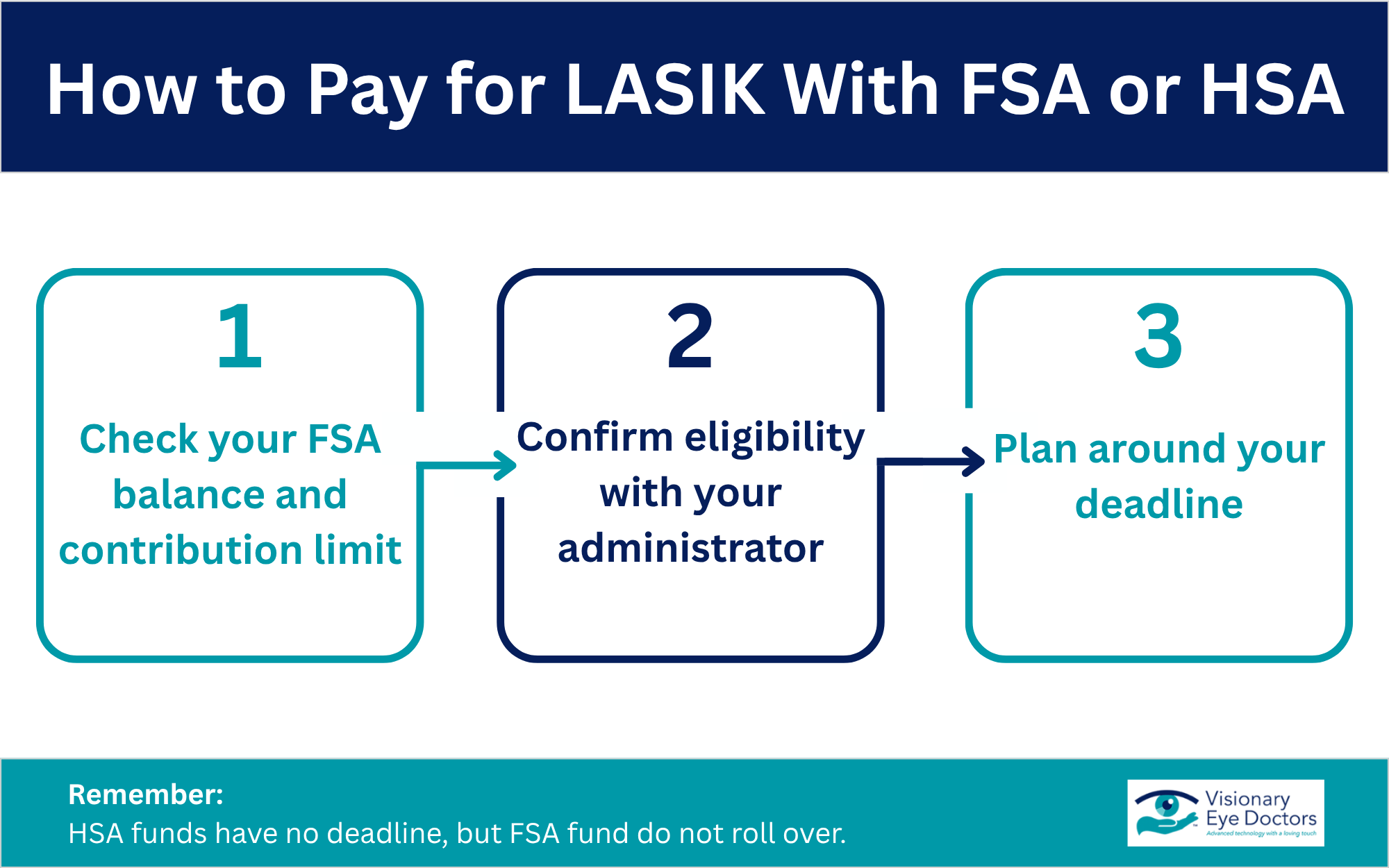
Using your account for LASIK eye surgery is a simple 3-step process.
1. Check your FSA balance and contribution limit
Look at how much you have in your account and how much you can still contribute. If LASIK is on your radar for next year, you can plan your election during open enrollment to cover more of the cost with pre-tax funds.
2. Confirm eligibility with your administrator
Call your FSA administrator or HSA administrator and ask whether LASIK is a covered medical expense under your plan. Most plans allow it, but confirming avoids surprises. Ask whether you pay with an account debit card or submit a receipt for reimbursement.
3. Plan around your deadline
HSA funds have no deadline, but many FSA plans follow a use-it-or-lose-it rule, with two possible exceptions your employer may offer.
- Carryover: You may roll over up to a certain amount of money into the next year.
- Grace period: Your plan may give you up to two and a half extra months after the plan year ends to use the remaining balance.
A plan can offer one of these options, not both. Knowing which one applies helps you schedule surgery before any money is forfeited.
Smart Ways to Stretch Your FSA or HSA for LASIK
A few planning moves help you get more value toward clearer vision.
- Schedule LASIK near year-end if you have an FSA balance you would otherwise lose.
- If both you and a spouse have FSA accounts, each can contribute up to the annual limit, which can help with patients needing LASIK on both eyes.
- Pair your account funds with any financing your eye surgeon offers to cover the rest of the healthcare costs.
- Keep every receipt in case your plan asks for documentation.
Because LASIK is a larger expense than prescription eyeglasses or contact lenses, a little planning around your FSA plan or HSA account goes a long way.
Ready to See Clearly? Talk to Visionary Eye Doctors
Visionary Eye Doctors provides trusted LASIK and vision correction care for patients in Washington, DC. Our team will walk you through your options, answer questions about using your FSA or HSA, and build a care plan around your eyes and your budget.
If you are thinking about LASIK, now is a good time to act before your FSA balance resets. Book an appointment today and take the next step toward clear vision.
Frequently Asked Questions
What happens to unused FSA funds?
It depends on your plan. Some plans let you carry over up to $680 into the next year. Others offer a grace period of up to two and a half months. Many plans follow a use-it-or-lose-it rule, so check before the plan year ends.
Does health insurance cover LASIK?
Usually not. LASIK is considered an elective procedure, so most insurance plans do not pay for it. That is why FSA and HSA accounts are a popular way to cover the cost.
Can I use FSA for eyeglasses and contacts too?
Yes. Prescription eyeglasses, prescription sunglasses, and contact lenses are all eligible expenses, along with routine eye exams.
Can I use my FSA or HSA to pay for a family member’s LASIK?
Yes. You can use your funds for LASIK for yourself, your spouse, and your tax dependents. The account holder does not have to be the person getting surgery, as long as the family member qualifies under your plan.
What if my FSA balance does not cover the full cost of LASIK?
You can use your FSA dollars toward part of the cost and pay the remaining balance another way, like a credit card, savings, or a payment plan from your eye surgeon. Many LASIK patients split the cost this way.